My Story
Trauma, Healing, and Hope
My name is Markus Hänni. I live in Switzerland.
Since birth, I have lived with Cystic Fibrosis (CF), a life-limiting genetic condition.
My lungs were repeatedly affected by severe infections, and much of my life was shaped by tension, uncertainty, fear, and frequent hospital stays.
For decades, I took more than 25 tablets a day and spent an additional three hours daily on breathing and inhalation therapies.
My body lived in a constant state of inner alarm:
• “Will I become ill again tomorrow?”
• “Will I have to return to the hospital?”
• “Will I have to give up my plans once more?”
• “Will my condition ever become stable again?”
By the age of 40, I had spent a total of four years in hospital.
Again and again, infections. Again and again, the same feeling of helplessness.
Then came a turning point: Trikafta.
The medication completely stopped the severe infections.
Since then, I have not required another hospital admission.
Physically, I was free.
Yet inwardly, I remained trapped.
My body had learned to live in a state of constant alertness.
This tension had once been a protective mechanism.
When the real threat disappeared, the fear remained as a shadow —
not always consciously, but stored within my body.
Particularly before holidays, travel, or unfamiliar situations, I sometimes experienced intense
physical symptoms.
My mind knew: I am healthy.
But my body was still living in the past.
At first, we assumed the symptoms were related to CF.
Yet medical investigations revealed no clear explanation.
Gradually, I came to understand that many of these symptoms were psychosomatic —
expressions of fear and trauma that my body had carried for years.
I realised that my nervous system needed healing.
I had survived — but my body did not yet know it.
Anyone who has experienced a panic attack may recognise this feeling:
"You die a thousand deaths, yet you keep living."
The body experiences danger where none exists.
This is not a sign of weakness. It is a sign of a nervous system that has spent too long in
survival mode.
I began to understand my body's signals more clearly and to develop a more mindful
relationship with them.
This allowed me to make sense of my symptoms and begin a healing process rooted
in self-acceptance, patience, compassionate self-awareness, and my personal
spiritual faith.
I intentionally looked for an experience that would help me face my fears.
I did not want to travel simply to pursue a hobby or distract myself.
I longed for something that would nourish my heart — for meaningful encounters, genuine
human connection, immersion in another culture, and a place that resonated with my inner
journey while broadening my perspective.
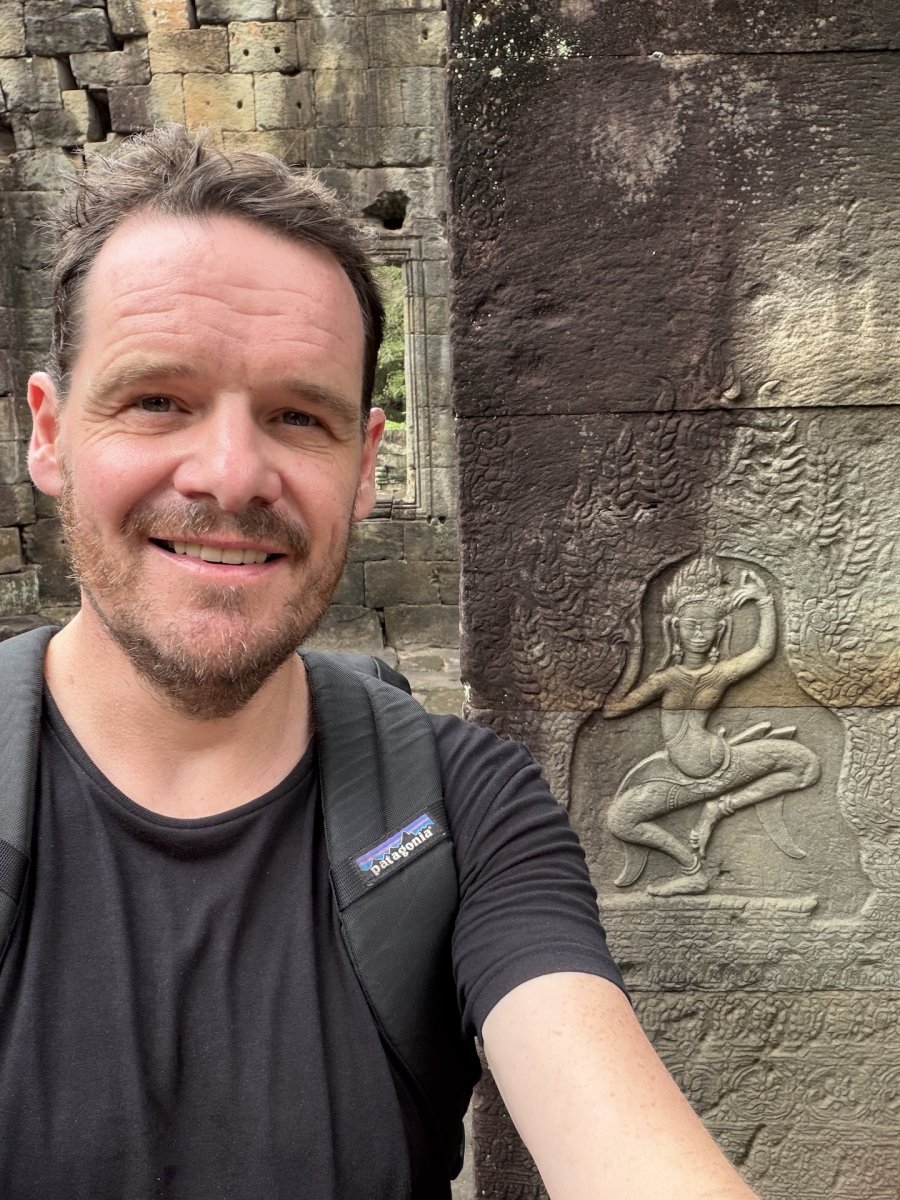
My wife suggested Cambodia.
There is an organization there called ICF Cambodia, which we have known and supported
through our ICF church in Bern for many years, including through our sponsored child.
That connection made all the difference.
Cambodia was not simply another travel destination. It was a place of meaning and
significance.
I consciously chose to make this journey alone.
Not as a test of courage. Not to prove anything to myself. But to show something to the
deepest parts of me:
"You are safe.
You are allowed to open yourself to life again."
Travelling alone required me to stay present, take responsibility, and allow my nervous
system to experience something new — one step at a time.
I met people who embodied hope despite difficult life circumstances.
Every encounter, every conversation, and every new experience helped me remain grounded
in the present moment and safely engage with old trauma in a conscious and self-directed
way.
I came to realise:
Trauma loses its power when we are willing to meet it consciously — with awareness,
self-trust, positive experiences, and, for me, in the light of faith.
My connection with ICF Cambodia provided guidance, relationships, and support that
touched my heart deeply.
Step by step, I began to understand:
Healing happens through intentional engagement, self-efficacy, and trust — and fear
gradually loses its influence when we meet it with presence and courage.
Alongside this journey, I drew upon:
• encouraging inner messages
• breathing practices
• psychotherapeutic support
• knowledge about trauma
• my faith in Jesus
...to gradually restore a sense of safety, calm, and balance between body and mind.
Healing is not a destination. It is a journey.
In the biblical narratives, Jesus knew fear, abandonment, and suffering.
Within the Christian faith, His suffering on the cross is understood as a profound sign of
solidarity with human pain and suffering.
When I bring my fears before God in prayer or in an inner dialogue with Him, my experience
can begin to change — often quietly and gradually.
Inner pressure can ease. A deeper sense of calm and spaciousness can emerge.
Prayer creates a space where I can acknowledge, process, and integrate fear through the
interplay of thoughts, emotions, and bodily sensations.
"Come to me, all who are weary and burdened, and I will give you rest."
(Matthew 11:28)
Through this, a holistic experience emerges that I understand as a connection between heart,
body, and soul.
Today, I know this:
Healing does not mean that everything is perfect.
It means that I can trust life again.
My story has taught me:
• to take my body's signals seriously
• not to fight fear, but to understand it
• to take responsibility for my inner world
For me, faith, knowledge, and experience belong together.
From this, a way of life has emerged that continues to sustain me — in life, in faith, and in my
encounters with other people.
On my own journey, I have learned that healing often happens through small, intentional
steps.
What strengthens one person may be different for another. For me, some helpful practices
have included:
• breathing consciously and returning to the present moment
• sharing thoughts and feelings with trusted people
• treating myself with patience
• allowing encouraging inner messages to take root
• making space for hope, even when it feels quiet
• finding a place of peace and support through faith or prayer
Books and Personal Reflections
Because Every Breath Counts
Actually, I Should Be Dead by Now, ...
